


Every time someone finds out I write about credit cards for a living, the question comes up almost immediately: “So which type of rewards card is actually worth it?”
It’s a fair question — and an important one, because the wrong answer can cost you hundreds of dollars a year in unrealized value. The credit card industry has done a masterful job of making all three reward types sound equally appealing, but the truth is that cash back vs rewards points vs travel miles is not a close race for every person. The “winner” depends almost entirely on two things: how often you travel, and how much mental energy you’re willing to spend managing your rewards.
In this guide, I’m going to break down all three reward types from the ground up — how they work, what they’re actually worth in dollar terms, and how to figure out which one belongs in your wallet. By the end, you’ll have a clear, honest answer to the question of best rewards type for me.
The Three Reward Types at a Glance
Before we get into the head-to-head comparison, let’s make sure we’re talking about the same things.
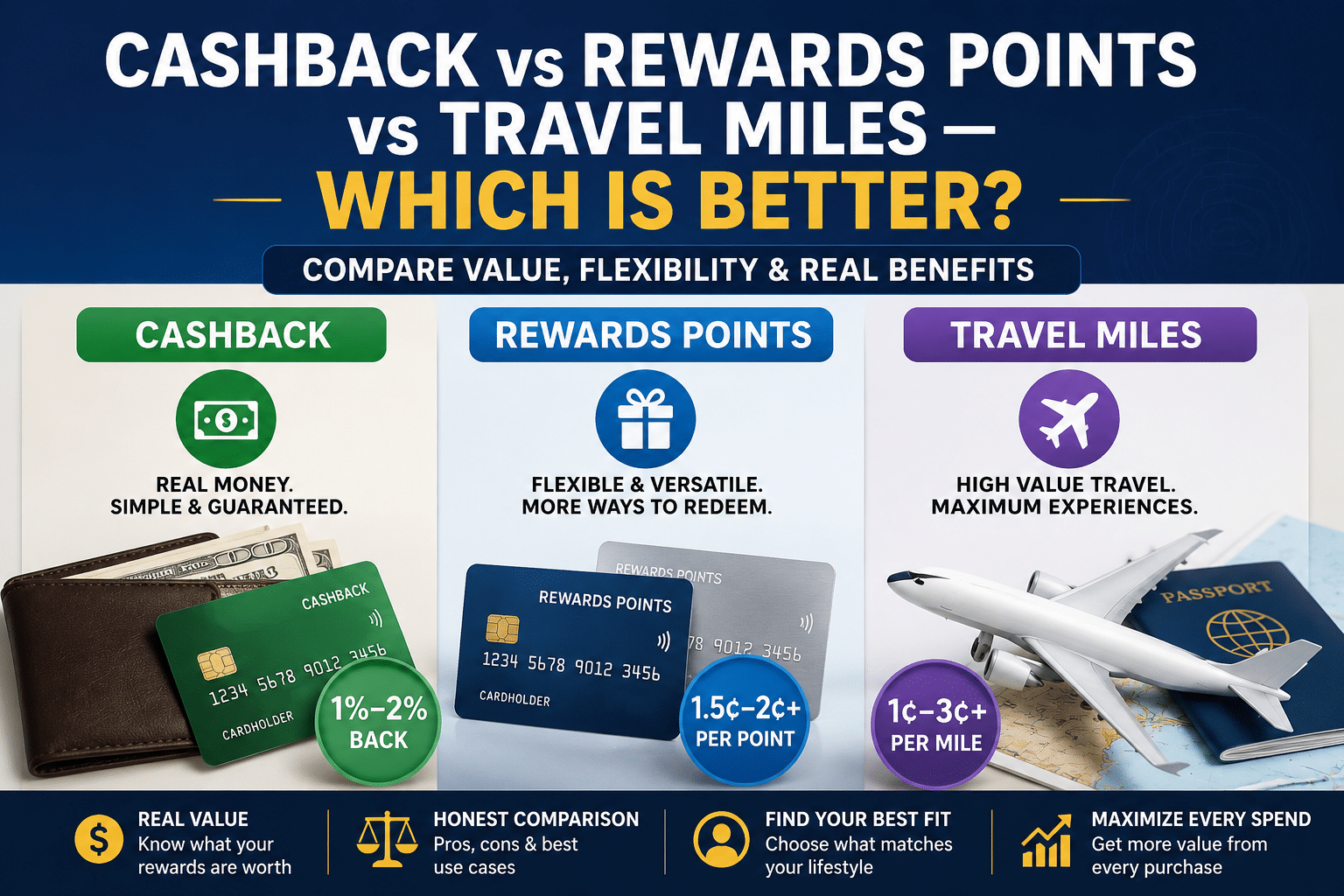
Cashback is straightforward: a percentage of every purchase comes back to you as real money — statement credits, bank transfers, or checks. There’s no conversion rate, no transfer partner, no award chart. One dollar of cashback is worth exactly one dollar.
Rewards points is a broader category that covers bank-issued currencies like Chase Ultimate Rewards, American Express Membership Rewards, Capital One Miles, and Citi ThankYou Points. These are flexible — you can redeem them for cash, transfer them to airline or hotel loyalty programs, or use them to book travel directly through the issuer’s portal. Their value fluctuates depending on how you use them.
Travel miles refers to airline-specific currencies — Delta SkyMiles, United MileagePlus miles, American Airlines AAdvantage miles, and so on — as well as hotel points like Marriott Bonvoy or Hilton Honors. These are purpose-built for travel redemptions and can deliver outsized value when used strategically, but they’re also the least flexible.
Value-Per-Point Benchmarks: What Are Your Rewards Actually Worth?
This is the section most comparison guides skip, and it’s a mistake. You can’t make an informed decision about cashback vs travel miles without understanding the baseline dollar value of each reward type.
Here’s a benchmark table based on widely used industry valuations:
| Reward Type | Typical Value Per Point/Mile | Best-Case Value | Worst-Case Value |
|---|---|---|---|
| Cashback | 1.0¢ | 1.0¢ | 1.0¢ |
| Chase Ultimate Rewards | 1.5–2.0¢ | 2.5¢+ (transfer to Hyatt) | 1.0¢ (cash redemption) |
| Amex Membership Rewards | 1.5–2.0¢ | 2.5¢+ (transfer to airlines) | 0.6¢ (gift cards) |
| Capital One Miles | 1.0–1.7¢ | 1.7¢ (transfer partners) | 0.5¢ (poor redemptions) |
| Delta SkyMiles | 1.1–1.3¢ | 3.0¢+ (business class) | 0.5¢ (overpriced awards) |
| United MileagePlus | 1.2–1.5¢ | 3.5¢+ (partner awards) | 0.7¢ (poor routing) |
| Marriott Bonvoy | 0.7–0.9¢ | 1.5¢+ (peak luxury hotels) | 0.3¢ (off-peak/poor use) |
| Hilton Honors | 0.4–0.6¢ | 1.2¢+ (aspirational hotels) | 0.2¢ (poor use) |
A few things stand out immediately. First, cashback has zero variance — 1.0¢ is always 1.0¢. Second, flexible bank points like Chase Ultimate Rewards and Amex Membership Rewards can significantly outperform their cash value when transferred to travel partners, but they also tank in value when redeemed poorly (like for gift cards). Third, airline miles and hotel points have enormous swings between best-case and worst-case value — some of the widest ranges of any financial product you’ll encounter.
The key takeaway: higher potential value always comes with higher redemption complexity. Cashback never disappoints because it never surprises.
Cash Back vs Rewards Points: The Flexibility Battle
Let’s start with the comparison that trips up the most people: cash back vs rewards points.
On the surface, a 2% flat-rate cashback card and a 2x points card might seem identical. Both return 2 units per dollar spent. But the practical difference can be significant.
The Case for Cashback
If you’re the kind of person who wants to earn rewards and never think about them again, cashback wins. There are no transfer partners to learn, no blackout dates to navigate, no award charts to decode. You spend, you earn, you redeem. The entire process takes about thirty seconds.
Cashback is also completely immune to devaluation. Airlines and hotels routinely devalue their loyalty currencies — sometimes with little notice, sometimes dramatically. Your cashback balance is always worth exactly what it says it is. In an era when SkyMiles, Bonvoy points, and even bank points have all seen purchasing power erode, that stability is genuinely valuable.
The downside of cashback is its ceiling. Even the best flat-rate cards cap out at around 2% on general spending. A rewards points enthusiast who books business class flights through transfer partners can extract 3¢, 4¢, or even 5¢ per point — making their effective “earn rate” on a 2x card anywhere from 6% to 10% when measured in travel value. Cashback simply cannot compete with that ceiling.
The Case for Flexible Rewards Points
Flexible bank points are the middle ground that many experienced cardholders settle on. You get the optionality to redeem for cash if you need to (usually at 1.0–1.25¢ per point), but you also retain the ability to transfer to travel partners when a high-value redemption opportunity arises.
The best use case: you earn 100,000 Chase Ultimate Rewards points over a year. If you redeem for cash, that’s $1,000. If you transfer to Hyatt and book a luxury hotel, those same points might cover $2,500 or more in rooms. The difference is meaningful.
But this only works if you’re willing to learn the system. Transfer partners, award availability, point expiration policies, minimum transfer amounts — these are all variables you need to manage. For a lot of people, that overhead isn’t worth the upside.
Bottom line on cash back vs rewards points: If you travel at least a few times a year and enjoy a moderate level of optimization, flexible points cards will likely outperform cashback over time. If you travel rarely or want zero complexity, cashback wins.
Cashback vs Travel Miles: The High-Stakes Comparison
Now for the comparison with the widest potential gap in both directions: cashback vs travel miles.
Airline miles and hotel points are the most powerful reward currency in the world — when used correctly. They’re also the easiest to misuse, hoard indefinitely, or simply lose to devaluation.
When Travel Miles Absolutely Win
If you fly regularly — even just two or three times a year — and you’re willing to learn the basics of award booking, airline miles can deliver value that is genuinely hard to replicate with any other financial product.
Consider this: a round-trip business class ticket to Europe on a premium carrier might cost $4,000–$7,000 in cash. That same flight might require 70,000–100,000 miles through the right loyalty program. At 70,000 miles for a $5,000 ticket, you’re extracting roughly 7¢ per mile — seven times the value of a cashback point. Even at the low end of that range, the delta is striking.
Hotel points work similarly for aspirational properties. A luxury resort in the Maldives or Tokyo might run $800–$1,200 per night in cash. Redeeming 60,000–80,000 Hyatt or Marriott points for that same room pushes your per-point value well above 1.5¢ — comfortably ahead of cashback.
When Travel Miles Fall Short
The flip side is equally important. Travel miles are not liquid. You cannot pay your electricity bill with SkyMiles. If your travel plans change — a job loss, a new baby, a global pandemic — your miles sit idle, slowly depreciating as the airline adjusts its award charts.
Miles also require redemption skill. The same 50,000 Delta miles that covers a coach round-trip to the Caribbean might only get you halfway to Europe in a poorly timed or poorly routed booking. Inexperienced redeemers frequently get less than 1.0¢ per mile — below what they’d have earned with cashback.
Additionally, most airline miles expire after 18–24 months of account inactivity. Cashback doesn’t expire. Points from major bank issuers often don’t expire as long as the account is open. Miles require you to remain an active member, which can be a genuine burden if you’re not a frequent traveler.
The Decision Framework: Which Reward Type Is Right for You?
By now you should have a clearer sense of where each reward type excels. But let’s make it concrete. Here’s how to determine the best rewards type for me — or for you.
If You Travel 0–1 Times Per Year: Choose Cashback
This one is clear-cut. If you’re not getting on planes regularly, you have no business optimizing for airline miles. The flexibility premium of travel currencies simply isn’t available to you. A 2% flat-rate cashback card — or a tiered card that rewards your actual top spending categories — will outperform any travel card in your hands. Simplicity isn’t a consolation prize here; it’s the optimal strategy.
Best match: Flat-rate 2% cashback cards, or tiered cashback cards with strong grocery/dining/gas categories.
If You Travel 2–4 Times Per Year: Choose Flexible Points
This is the sweet spot for flexible bank points. You travel enough to take advantage of transfer partner opportunities when they arise, but not so frequently that you’d benefit from aligning deeply with a single airline or hotel program. With a card like Chase Sapphire Preferred or Amex Gold, you earn points that are functionally cashback when you need them — and powerful travel currency when you don’t.
The key discipline here: don’t let points accumulate without a plan. If you’ve been sitting on 200,000 Chase points for three years without redeeming, they’re not doing you any good. Set a redemption target — a trip, a hotel stay, a flight upgrade — and work backward from it.
Best match: Chase Ultimate Rewards, Amex Membership Rewards, Capital One Miles, or Citi ThankYou Points ecosystems.
If You Travel 5+ Times Per Year (Especially Internationally): Choose Travel Miles
Frequent travelers — particularly those who fly internationally or aspire to premium cabin travel — get the most out of airline miles and hotel points. The redemption math becomes dramatically favorable once you’re booking business or first class, and the ancillary benefits of co-branded airline cards (free checked bags, priority boarding, lounge access) have real cash value that adds up quickly across multiple annual trips.
If you’re in this camp, it’s worth choosing one or two programs to concentrate your earning in rather than spreading across three or four loyalty currencies. Miles and points have compounding value when you accumulate enough of them to pursue high-value redemptions — a scattered approach dilutes that benefit.
Best match: Airline co-branded cards (Delta, United, American, Southwest) paired with a hotel program card (Hyatt, Marriott, or Hilton depending on your brand loyalty).
A Quick Word on Combining All Three
It’s worth noting that the most optimized cardholders don’t pick just one type — they layer them. A common setup might be:
- A flat-rate 2% cashback card for everyday purchases that don’t fall into a bonus category
- A flexible points card for groceries, dining, and travel
- An airline card for flights on a preferred carrier, unlocking status perks
This kind of multi-card setup can maximize value across all spending, but it also adds meaningful complexity to manage. It’s the right approach only if you’re genuinely interested in optimizing your rewards — not if it feels like a second job.
The Honest Bottom Line
The debate over cash back vs rewards points and cashback vs travel miles doesn’t have a universal winner. It has a personal winner — one that depends on your life, your travel habits, and your tolerance for complexity.
If you travel rarely and want zero fuss: cashback is your best rewards type. If you travel occasionally and want upside potential: flexible points give you both worlds. If you travel frequently and are willing to learn the game: travel miles can be transformative.
The worst outcome isn’t choosing the “wrong” type — it’s spending years earning rewards you never use, or using them so inefficiently that you’d have been better off with a debit card. Know your habits, match your card to your life, and actually redeem what you earn.
That’s the whole secret. Everything else is just fine print.
This article is for informational purposes only and does not constitute financial or investment advice. Reward valuations are estimates based on common industry benchmarks and may vary based on individual redemption choices and program changes.
