


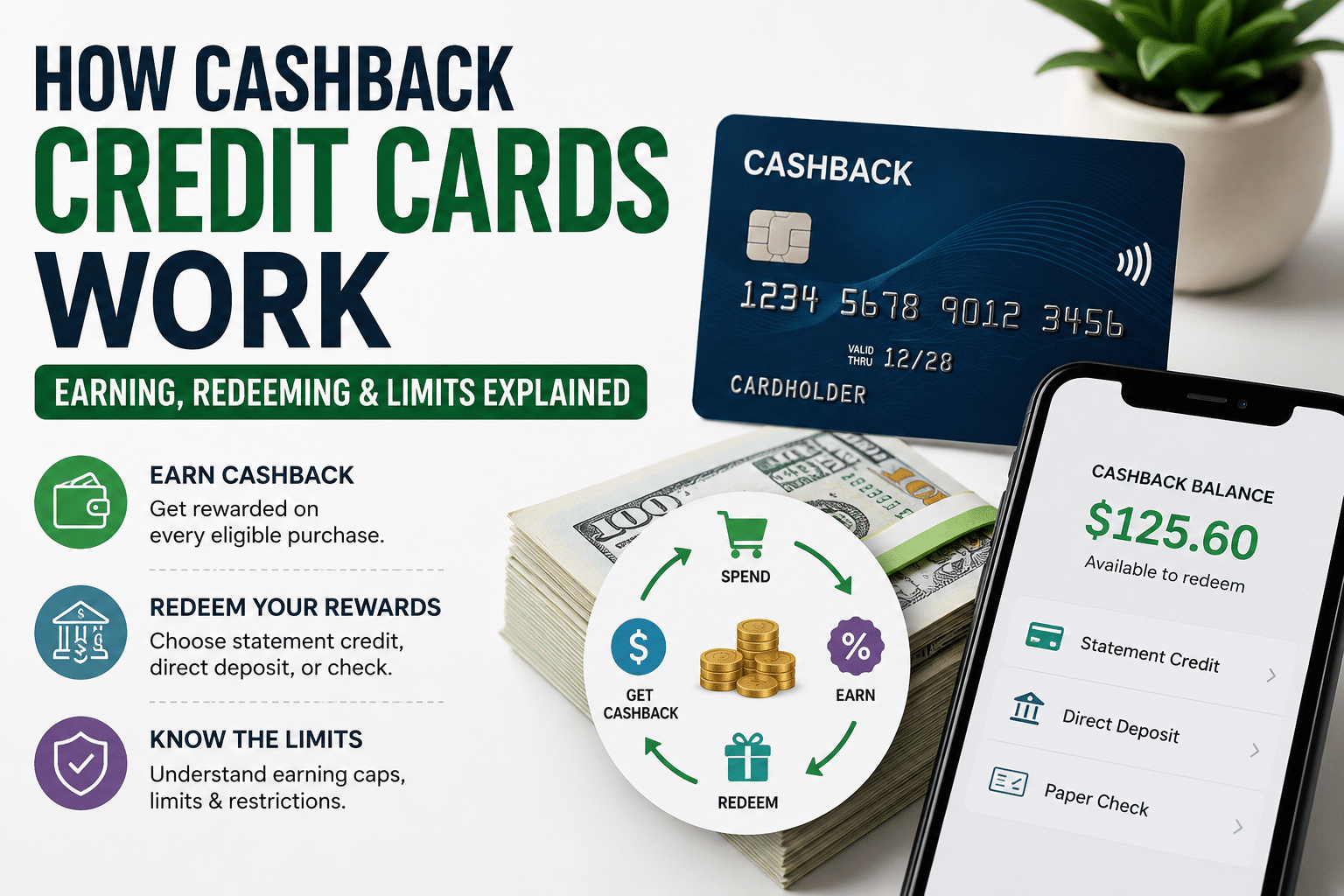
I’ve spent years writing about personal finance, and if there’s one product that consistently confuses people — even savvy spenders — it’s the cashback credit card. On the surface, the concept sounds simple: spend money, get some back. But once you dig into earning tiers, the cashback redemption process, and the often-overlooked cashback earning limits, the picture gets a lot more nuanced.
In this post, I’m going to walk you through the entire lifecycle of a cashback reward — from the moment you swipe your card to the moment that money lands back in your pocket. I’ll also include a detailed worked example so you can see exactly how the math plays out in real life.
What Is Cashback, and How Does Cashback Work on Credit Cards?
Let’s start at the very beginning. When you use a cashback credit card, your card issuer pays you a small percentage of every eligible purchase you make. This money comes primarily from interchange fees — the processing fees that merchants pay to accept card payments, which typically run between 1.5% and 3.5% of each transaction. Card issuers share a slice of that revenue with you as an incentive to keep using their card.
So when you’re asking how does cashback work on credit cards, the short answer is: the bank is effectively giving you a rebate funded by the merchants you shop with.
The percentage you receive is called your earning rate, and this is where things start to get interesting.
How Cashback Earning Rates Work
Not all purchases earn at the same rate. Card issuers use earning rate structures to reward spending in categories that are either highly profitable for them or particularly attractive to their target customer base. Here are the most common structures you’ll encounter:
Flat-Rate Cards
These are the simplest cashback cards to understand. You earn the same percentage on every purchase, regardless of category — typically 1.5% or 2% back on everything. There’s no need to track categories or rotate bonuses. If simplicity is your priority, a flat-rate card is usually the right call.
Tiered-Rate Cards
Tiered cards assign different earning rates to different spending categories. For example, a card might offer:
- 5% back on travel booked through the issuer’s portal
- 3% back on dining and drugstore purchases
- 1% back on everything else
These cards reward you generously for the categories where you spend most, but they require a bit more attention to make sure you’re always using the right card for each purchase.
Rotating Category Cards
Some cards offer bonus cashback — often 5% — in categories that change every quarter (think groceries in Q1, gas stations in Q2, Amazon in Q3, etc.). The catch is that you usually have to activate the bonus each quarter, and the elevated rate only applies up to a spending cap. Miss the activation window, and you earn the standard rate by default.
Sign-Up Bonus Rates
Many cards also offer an introductory elevated earning rate or a lump-sum cashback bonus for hitting a minimum spend threshold within the first few months. These can range from $150 to $300 or more, and they represent some of the most straightforward value you can extract from a new card.
Understanding Cashback Earning Limits
Here’s where many cardholders get tripped up. Most people assume their bonus earning rate applies to unlimited spending — but that’s rarely the case. Cashback earning limits, also called earning caps, restrict how much you can earn at the elevated rate before you drop back to the standard rate.
How Earning Caps Are Structured
Caps are typically applied on one of three timelines:
- Quarterly caps — Common on rotating category cards. For example, 5% back on groceries up to $1,500 in spending per quarter ($75 max bonus per quarter).
- Annual caps — More common on tiered cards. You might earn 3% on dining up to $6,000 in annual spending, then 1% after that.
- Per-category caps — Some cards cap each bonus category independently, so hitting the grocery cap doesn’t affect your dining rewards.
Why Caps Matter More Than You Think
If you’re a heavy spender in a bonus category, caps can dramatically reduce your effective earning rate. A card advertising “5% back on groceries” sounds incredible — until you realize that bonus maxes out at $1,500 in quarterly spending. A family spending $800/month on groceries ($2,400 per quarter) would hit that cap partway through the quarter and earn the standard 1% on the remaining $900. Their blended rate works out to roughly 2.6%, not 5%.
Understanding your own spending habits relative to these limits is essential to choosing the right card — and to knowing when to switch cards mid-month once you’ve hit a cap.
A Detailed Worked Example: One Month of Cashback Earning
Let’s put all of this together with a realistic scenario. Meet Sarah, a freelance designer who holds a popular tiered cashback credit card with the following structure:
| Category | Earning Rate | Annual Cap |
|---|---|---|
| Groceries | 3% | $6,000/year |
| Gas & Transit | 3% | $6,000/year |
| Dining & Restaurants | 3% | $6,000/year |
| All Other Purchases | 1% | Unlimited |
Sarah’s spending for a single month looks like this:
| Purchase | Amount | Category |
|---|---|---|
| Grocery store | $320 | Groceries |
| Restaurant dinners (×4) | $180 | Dining |
| Gas station fill-ups (×3) | $90 | Gas |
| Online software subscription | $49 | Other |
| Clothing purchase | $110 | Other |
| Pharmacy | $35 | Other |
| Total Spending | $784 | — |
Calculating her cashback:
- Groceries: $320 × 3% = $9.60
- Dining: $180 × 3% = $5.40
- Gas: $90 × 3% = $2.70
- Other (software + clothing + pharmacy): ($49 + $110 + $35) × 1% = $194 × 1% = $1.94
Total cashback earned this month: $19.64
Now, is Sarah anywhere near her annual cap? Let’s check. She’s spent $320 on groceries this month. Annualized, that’s roughly $3,840 — well below the $6,000 grocery cap. She has plenty of room to keep earning at 3% through the rest of the year.
But suppose Sarah has a particularly heavy month in November — holiday grocery hauls, work dinners, and extra gas for road trips. If her year-to-date grocery spending reaches $5,800 by late November, she’d only earn 3% on the next $200 in grocery purchases before the cap kicks in. Every grocery dollar after that earns just 1% for the remainder of the year.
The lesson: Tracking your cumulative category spending throughout the year helps you avoid hitting caps unaware — and tells you when it makes sense to switch to a different card for that category.
The Cashback Redemption Process: Your Options Explained
Earning cashback is only half the equation. You also need to know how to actually get your money. The cashback redemption process varies by issuer, but most cards offer some combination of the following methods.
Statement Credit
This is the most common redemption method. You log into your card account, navigate to the rewards section, and apply your accumulated cashback as a credit against your current statement balance. The money reduces what you owe — though it doesn’t count as a payment, so you still need to make at least your minimum payment separately.
Best for: People who want to reduce their monthly bill with minimal effort.
Watch out for: Minimum redemption thresholds. Some cards require you to accumulate at least $25 before you can redeem, which can be frustrating if you’re a light spender.
Direct Deposit / Bank Transfer
Many issuers now let you transfer your cashback directly to a linked checking or savings account. This is arguably the most flexible option because it gives you actual cash that you can use for anything — not just to offset your credit card balance.
Best for: People who want their rewards in real money rather than as a credit against spending.
Processing time: Transfers typically take one to three business days, though some issuers offer instant transfers.
Check
A few issuers will mail you a physical check for your cashback balance. It’s an older method that’s becoming less common, but it’s still available on some cards — particularly those marketed to older demographics or those that don’t require online account access.
Best for: People who don’t link bank accounts to their credit card issuers, or those who simply prefer having a paper record.
Watch out for: Checks often have higher minimum redemption thresholds than statement credits or direct deposits, sometimes $20–$50.
Gift Cards and Shopping Portals
Some issuers also let you redeem cashback for gift cards or through their own shopping portals, often at a slightly elevated value (e.g., $25 in cashback might buy a $27 gift card). These can be good deals if you’re a loyal customer of a particular retailer — but they reduce flexibility, so they’re generally not the best default choice.
Automatic Redemption
A handful of cards — particularly flat-rate cash back cards — offer the option to automatically redeem your rewards each month, either as a statement credit or a direct deposit. If you’re the type to forget to manually redeem, enabling this feature ensures you never leave money on the table.
When Does Cashback Actually Post to Your Account?
This is a question I get constantly, and the answer depends on your issuer. In most cases, cashback is earned at the time of purchase but posted to your rewards balance at the end of your billing cycle, or sometimes when the transaction fully settles (which can take a day or two after the purchase date).
Some cards post rewards more quickly — even within 24 to 48 hours of a settled transaction — but you typically can’t redeem until you meet the card’s minimum balance threshold.
Importantly, if you return a purchase, the cashback associated with that transaction will be reversed. Always account for this if you’re planning a large redemption right after a return period.
Common Cashback Mistakes to Avoid
After years of following this space, I’ve seen the same errors come up again and again:
Ignoring earning caps. As I covered above, hitting a cap mid-year without realizing it means you’re leaving money on the table every time you swipe. Review your card’s terms annually and track your category spending.
Redeeming too early or in the wrong format. If your card offers a higher value for gift card redemptions versus statement credits, know the difference before you redeem. Conversely, if flexibility matters to you, don’t lock rewards into store credit.
Carrying a balance. This one is critical. Cashback rewards are almost never worth more than the interest you’d pay on a carried balance. A card earning 3% back means nothing if you’re paying 22% APR on a revolving balance. Cashback cards only make financial sense if you pay your statement in full every month.
Not using the right card for each category. If you have multiple cards, make sure you’re using the one with the best earning rate for each type of purchase. A simple cheat sheet on your phone can save you meaningful money over a year.
Final Thoughts
Understanding how does cashback work on credit cards — from the mechanics of earning rates and cashback earning limits to the nuances of the cashback redemption process — gives you a real edge as a consumer. These aren’t complicated financial instruments, but they do reward attention and intentionality.
The cardholders who get the most out of cashback cards are the ones who know their spending patterns, understand their card’s caps and tiers, pay their balance in full each month, and actually redeem their rewards rather than letting them sit idle. Do those four things consistently, and cashback cards become a genuinely useful financial tool — one that effectively gives you a small but permanent discount on everything you buy.
This post is for informational purposes only and does not constitute financial advice. Always review your card’s terms and conditions before applying.
